Agentic Reasoning · Fintech
Arbiter
Arbitrage intelligence for prediction markets.
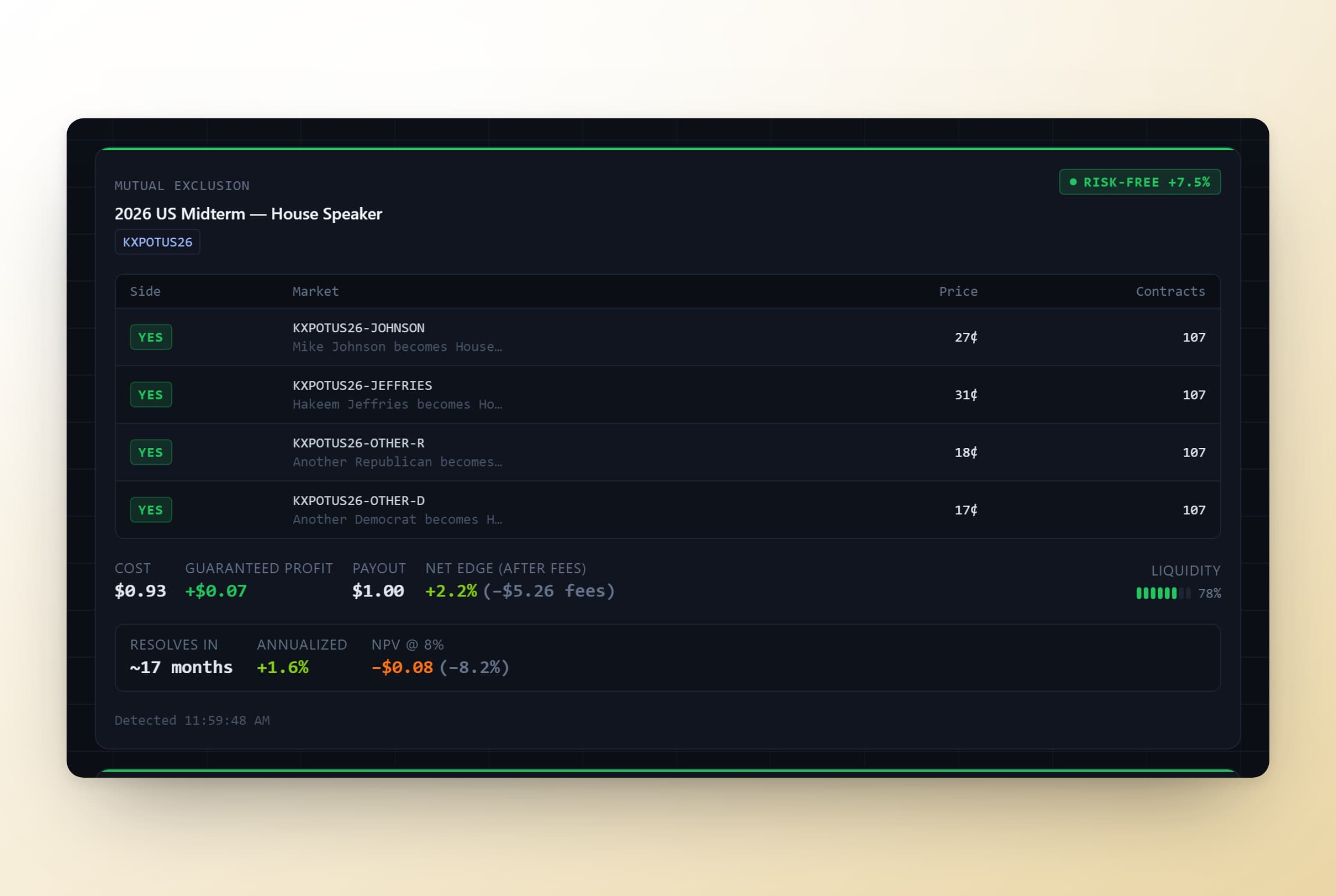
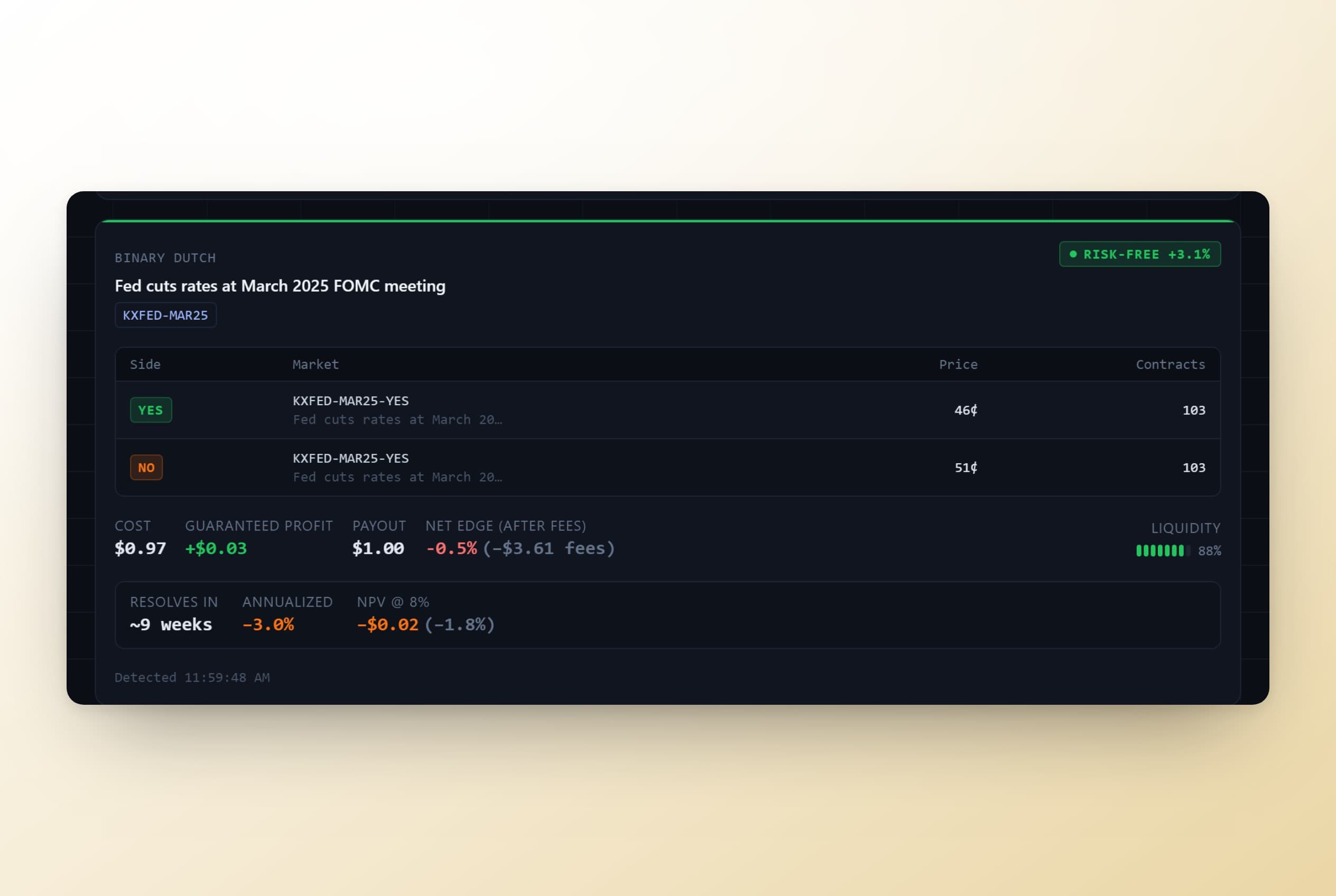
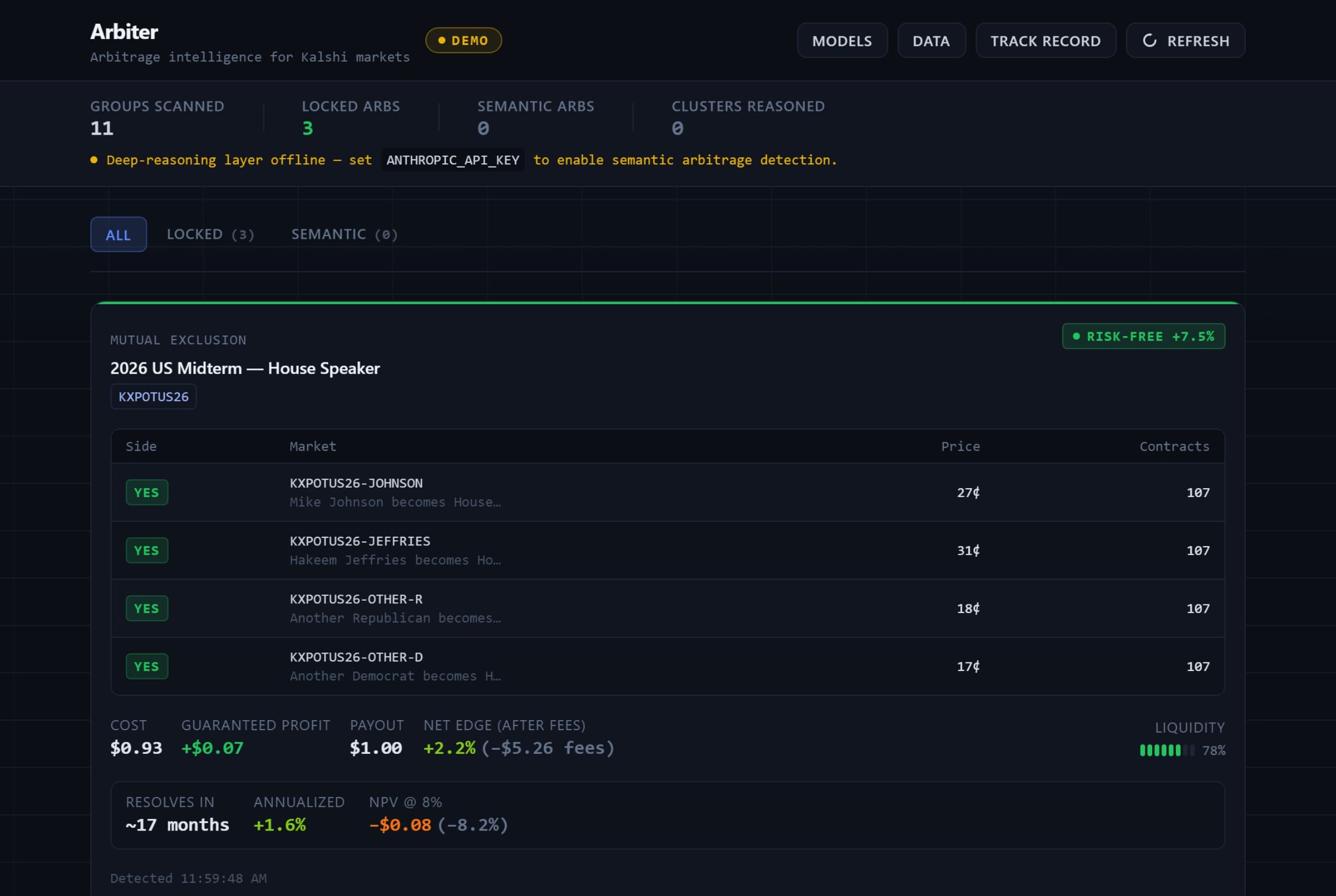
Scans Kalshi event markets for risk-free arbitrage with exact-cents math, then reasons over the non-obvious mispricings.
- Role
- Solo — research, engineering & design
- Year
- 2026
- Built with
- Next.js · Claude Opus 4.8 (adaptive thinking) · Zod structured outputs · Vercel
How it works
Scan
Pull a live snapshot of every open market.
Detect
Exact integer-cents math locks the risk-free arbitrage.
Reason
Claude Opus argues the non-obvious mispricings.
The problem
Prediction markets quietly contradict themselves. Two related contracts — ’S&P above 6000’ and ’above 5800’ — can be priced in ways that violate basic logic, but the inconsistency is buried across hundreds of markets and only visible if you reason about how they relate.
The build
Arbiter pulls a live snapshot of Kalshi markets and runs two layers. A deterministic engine finds locked, risk-free arbitrage with exact integer-cents math (dutch books and mutually-exclusive sets that pay out more than they cost). Everything is ranked by edge and rendered in a financial-terminal dashboard.
The AI technique
On top of the math sits a deep-reasoning layer. Logically-linked markets are clustered, then Claude Opus 4.8 — with adaptive thinking — reasons about whether the prices are internally consistent, emitting a structured, Zod-validated analysis: a thesis, a step-by-step argument, the logical links it found, an edge estimate, and the residual risks. The risk-free math is guaranteed; the reasoning shows its work.
The outcome
An advisory-only research tool — read-only market data, no order placement — that pairs provable arbitrage with transparent machine reasoning. A study in where deterministic code should end and a reasoning model should begin.
A closer look